What to take away
- Dedicated and programmable graphics processors existed before NVIDIA marketed the GeForce 256 as the first GPU in 1999.
- Programmable shaders and unified architectures made consumer graphics hardware more flexible.
- CUDA and OpenCL helped developers use GPU parallel processing for applications beyond graphics.
- AlexNet demonstrated the value of GPU training for image recognition in 2012; it did not invent deep learning.
- AI now influences GPU architecture, including specialized calculation units, memory, and connections between processors.
In 2012, a team at the University of Toronto trained a neural network using two NVIDIA GTX 580 graphics cards. The system, known as AlexNet, achieved a breakthrough in image recognition. Its entry in that year's ImageNet competition recorded a top-five error rate of 15.3 percent, compared with 26.2 percent for the runner-up. Hardware associated with video games had helped demonstrate a powerful new approach to artificial intelligence. AlexNet paper
That moment brought together decades of progress in graphics hardware, programming tools, and machine learning. The graphics processing unit, or GPU, had gradually evolved from a device for drawing images into a processor capable of handling many calculations at once. Understanding that transformation requires looking back well before the term "GPU" became familiar.
Computer graphics emerged alongside early interactive computing. In the 1950s, MIT's Whirlwind system combined a computer-controlled display with a light pen. In the following decade, Ivan Sutherland's Sketchpad demonstrated how people could create and manipulate drawings directly on a computer. These systems established ideas that would shape computer-aided design and graphical interfaces, although they were far removed from modern graphics cards. Computer History Museum
As graphics became more ambitious, producing images demanded more computation. A computer displaying a three-dimensional object must transform its coordinates, determine which parts are visible, and convert the scene into something a screen can show. Dedicated hardware offered a way to perform some of that work without placing the entire burden on the main processor.
One significant development was James Clark's Geometry Engine, described in a 1982 paper. It was a specialized processor designed to perform matrix transformations, clipping, and coordinate mapping. The technology helped establish the foundation for Silicon Graphics, whose systems became important tools in engineering, scientific visualization, and film production. Geometry Engine paper, Computer History Museum's SGI history
Graphics processors also developed along other paths. During the 1980s, Texas Instruments' TMS34010 combined general-purpose programming capabilities with instructions designed for graphics operations. It could manipulate pixels and perform raster operations under software control. This matters because programmable graphics hardware existed long before modern shader-based GPUs. The industry's later breakthroughs built on a substantial earlier history. Texas Instruments documentation
During the 1990s, increasingly demanding games helped expand the market for consumer graphics acceleration. Companies sought to bring sophisticated three-dimensional graphics to personal computers at prices far below those of professional workstations. In 1996, 3dfx began selling Voodoo Graphics chips, becoming a major name in the growing market for PC graphics hardware. Computer History Museum
Software standards helped that market develop. SGI introduced OpenGL in 1992, providing a common interface through which applications could use graphics hardware. Such interfaces gave developers a more consistent way to request rendering operations across different systems. Graphics history is therefore also a history of software: faster chips became more useful when programmers could access their capabilities. Khronos
In 1999, NVIDIA released the GeForce 256 and marketed it as the world's first GPU. Its hardware transformation and lighting capabilities moved additional stages of three-dimensional graphics processing onto the graphics chip. It was an important milestone in consumer hardware, but the "first GPU" description needs qualification. Dedicated graphics processors had existed for years; NVIDIA's claim reflected its definition of the new product category. NVIDIA's GeForce 256 retrospective
The next major change concerned flexibility. Earlier graphics pipelines largely relied on predetermined operations built into hardware. Programmable shaders allowed developers to write small programs that controlled parts of the rendering process. NVIDIA's GeForce3, introduced in 2001, was an important step in this transition. Its programmable vertex engine gave developers greater control over calculations applied to three-dimensional geometry. Contemporary SIGGRAPH paper
GPU architectures subsequently became more adaptable. ATI's Xenos chip for the Xbox 360 introduced unified shaders, followed by NVIDIA's GeForce 8800 on PCs in 2006. Instead of maintaining separate groups of processors for different shader tasks, a unified architecture could allocate a shared pool of processing resources according to the workload. That improved utilization and made the hardware more versatile. How GPUs Work
Competition also reshaped the industry. AMD completed its acquisition of ATI in October 2006, combining CPU and graphics expertise within one company. Its accompanying Fusion initiative proposed integrated CPU/GPU products, pointing toward closer cooperation between the two kinds of processor. AMD's acquisition announcement
By then, researchers were already exploring uses for graphics hardware beyond rendering. GPUs were designed for high throughput: they could perform many similar arithmetic operations across large amounts of data. That approach suited selected scientific and numerical problems, although it did not make GPUs faster than CPUs for every task. Stanford researchers were studying GPU implementations of matrix multiplication by 2004, including the architectural limitations that affected their efficiency. Stanford research
Programming tools made these applications easier to develop. CUDA 1.0 became available in 2007, giving developers a programming environment for computation on NVIDIA GPUs. OpenCL 1.0 followed in December 2008 as a cross-platform parallel programming standard. These tools helped expand the GPU's role from graphics hardware to a computational coprocessor. CUDA announcement, OpenCL announcement
A separate expansion was taking place in mobile devices. OpenGL ES, introduced in 2003, adapted graphics programming for hardware with tighter resource constraints. Accelerated graphics became part of the experience of using smartphones and embedded systems, extending the GPU's reach beyond desktop computers and consoles. Khronos historical account
AlexNet's success in 2012 showed what GPU computing could contribute to machine learning. The researchers reported that their network took five to six days to train on two GTX 580 GPUs. The result did not mark the invention of deep learning, but it demonstrated how suitable hardware, effective training methods, and a large dataset could work together to produce a substantial advance. AlexNet paper
AI subsequently began shaping GPU design itself. NVIDIA's Volta architecture, announced in 2017, introduced Tensor Cores designed to accelerate calculations important to neural networks. In 2018, Turing-based RTX products added dedicated ray-tracing hardware alongside programmable shaders and AI processing units. GPUs were becoming combinations of flexible processors and specialized engines. Volta announcement, RTX technical overview
The AI-focused products of the 2020s continued that development. AMD's MI300X launch in 2023 emphasized memory capacity and large-language-model workloads. NVIDIA's Blackwell announcement in 2024 emphasized AI computation and connections between processors. These products illustrate how GPU development increasingly encompasses entire computing systems, including memory, networking, and software. AMD's MI300 announcement, NVIDIA's Blackwell announcement
The GPU's history follows a recurring pattern: demanding applications encourage specialized hardware, and better programming tools reveal new uses for it. Graphics created a market for parallel processing. Programmability opened that processing power to science and machine learning. AI then became a force directing the next generation of hardware. The processor developed to help computers draw increasingly complex worlds now helps them analyze and generate information within those worlds.
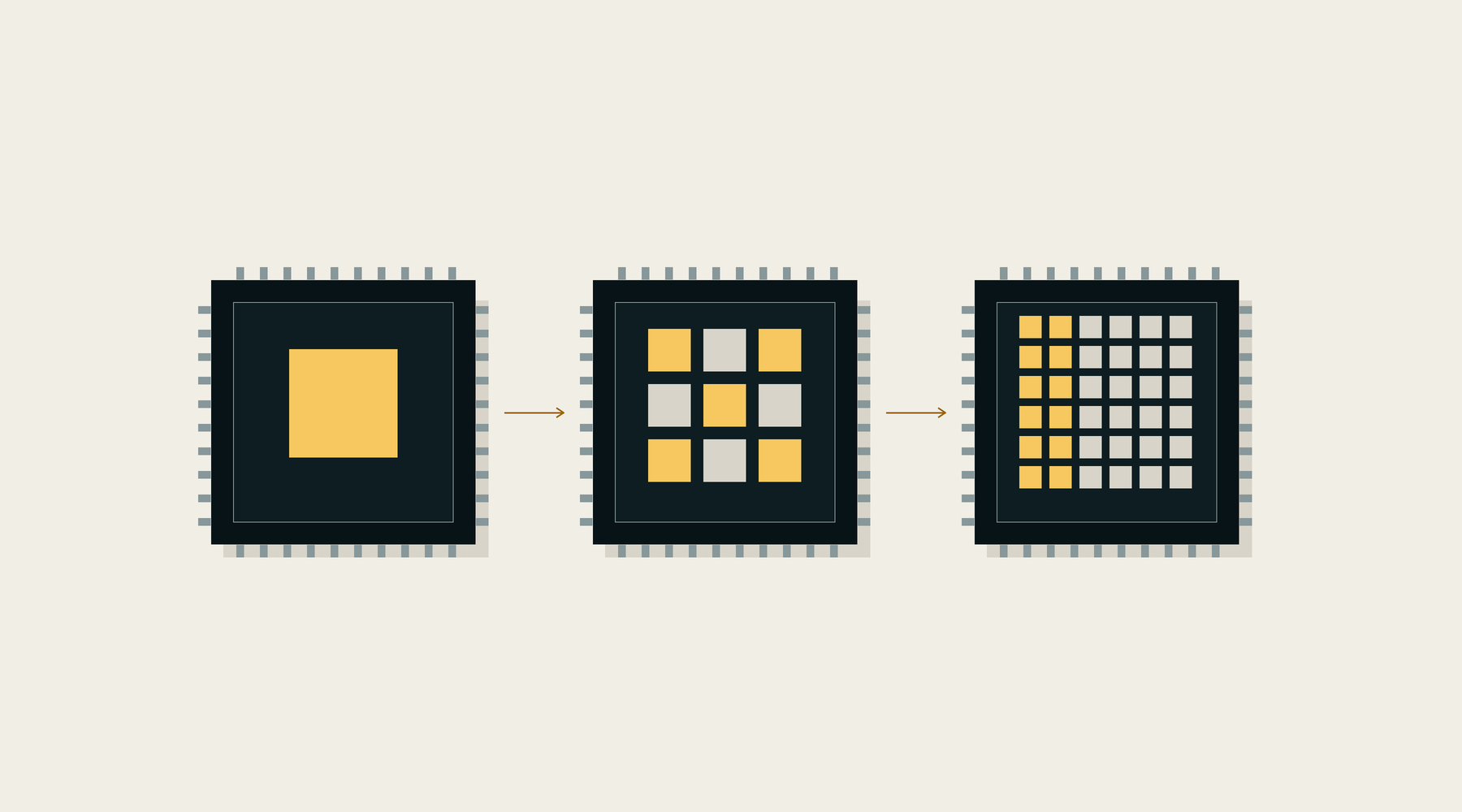
Method and sources: Researched September 27, 2026. This is a selected historical overview, with product examples through 2024, rather than an exhaustive chronology or a survey of the latest products. Technical claims draw on original papers, manufacturer documentation, standards announcements, and Computer History Museum histories linked beside the relevant passages. Manufacturer priority claims are attributed, and reported research results are not presented as Noach Ark measurements. Prepared with AI-assisted research and writing. The hero is an original conceptual illustration, not an exact chip diagram. Read Noach Ark's methodology.